Initially, the Greek-Illyrian community buried its dead in the courtyard of the old Church of St. Spyridon, without funeral rites. It was not until 1772 that Empress Maria Theresa of Austria granted the community permission to establish its own cemetery.
In 1785, the Serbian community separated from the Greek community and built a new cemetery and chapel in the Barriera Vecchia area. A century later, the city’s urban development forced the Serbian community to relocate the cemetery. The present-day cemetery and its chapel, dedicated to St. George, were established at that time. All human remains were exhumed from the old cemetery in the city and transferred to the new site.
The Chapel of St. George is a small, single-nave building with a harmoniously proportioned portico topped by a small bellcote.
Set into the façade to the left of the entrance is a memorial tablet erected by Sava Damaskin of Nemet in memory of his beautiful wife Ekaterina, née Teodorovich. She died on October 13, 1930, aged twenty-four, after five years of marriage, leaving behind two beloved daughters.
A plaque set into the floor below marks the burial place of Ana Georgijeva Teodorovich, née Palicuchia, a widow who died on July 26, 1833.
To the right of the entrance is another memorial tablet commemorating Anastasija Risnich, who died on December 27, 1829.
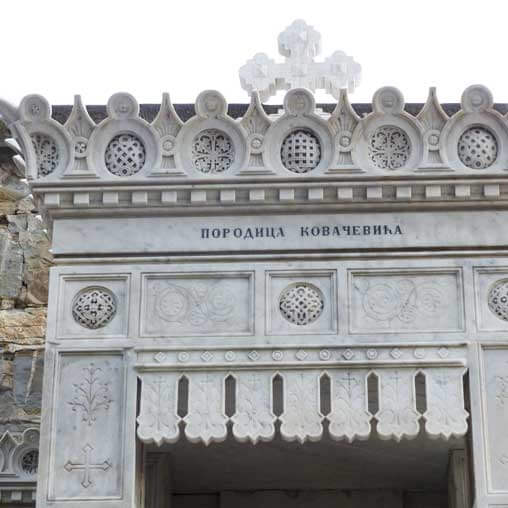
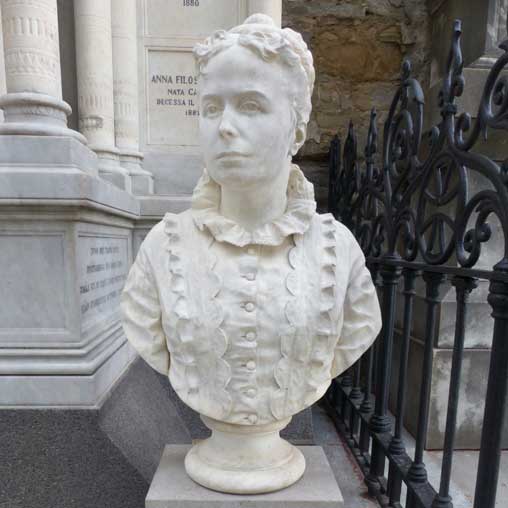
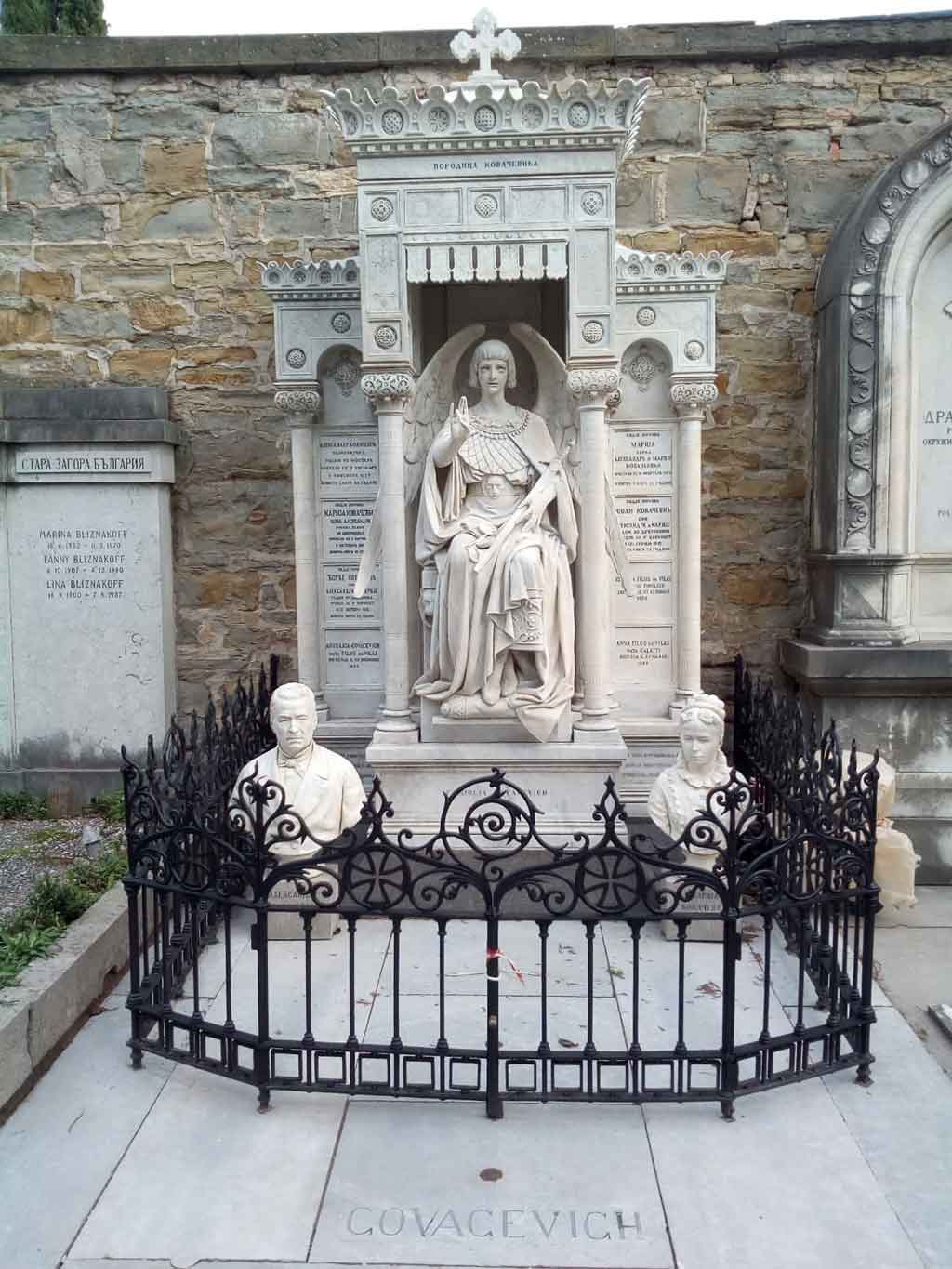
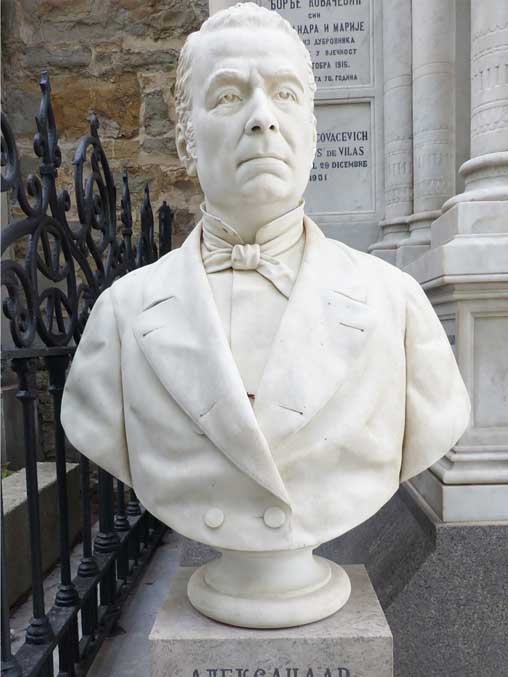
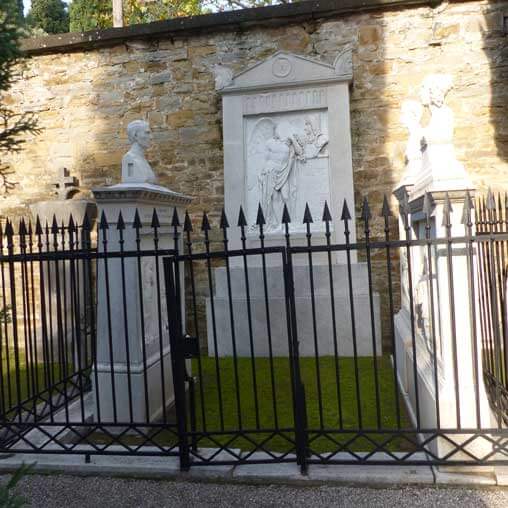
Members of several prominent families from Trieste were buried in this cemetery. Their lavish, richly decorated tombs bear witness to their prestige and wealth. Some feature marble reliefs, while others display busts of the deceased.
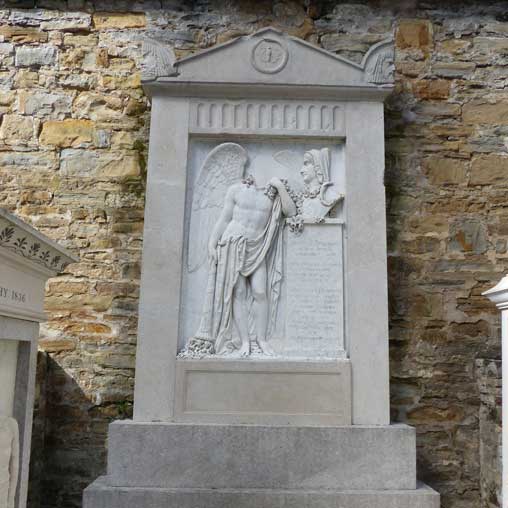
The decorative elements, and often the funerary monuments themselves, are predominantly Classical in style. Stelae adorned with bas-reliefs are particularly common, featuring classically inspired imagery expressing sorrow and mourning.
The Classical-style tomb of the journalist and physician Dr Dimitrije Frussich, for example, features a relief depicting women mourning beside a funerary urn. Another relief, showing two young men standing beside an urn, adorns the tomb of Lazar Bajovich.
The tomb of Anastasia Czvetcovich, who died on January 1, 1854, is particularly striking for its monumental scale. Erected by her husband, Cristoforo Popovich, it contains busts of several members of the Popovich family. Its exceptionally skilful carved decoration was produced in the local workshop of the stonemason Antonio Bosa.
Along the eastern wall of the cemetery stand the elaborate tombs of the Haggiconsta family, Captain Andrea Raicevich and Stevan Ivancovich. Their decoration predominantly features traditional motifs.
The most lavish is Stevan Ivancovich’s tomb, which features a seated female figure created by the Croatian sculptor Ivan Rendić in 1883–1885. At the time, Rendić lived and maintained his workshop in Trieste.
Today, these once magnificent tombs are covered in ivy and have fallen into disrepair, as the last members of these families passed away long ago. Only these stories told in stone remain, bearing witness to their achievements, great and small.
Gallery