



The life of a community can never be described and reduced only to a period of its existence; instead, looking through the prism of its activities in the past, its present can also be read. It has always been others, and probably will continue to be in the future, who have written about our community and its history. Instead, I would like to say a few words about its religious life and its main protagonists.
The Church is always the pulsating vein of every people and every community. In this sense, in my humble opinion, the Serbian Orthodox Church, acting through the Archdiocese of Sremski Karlovci, also played a decisive role in the preservation of the religious and national identity of the Serbian people in the Austro-Hungarian Empire, including our small Community. The establishment of the Archdiocese of Sremski Karlovci was based on the Patents issued by Emperor Leopold I on 21 August 1690, 11 December 1690, 20 August 1691 and 4 March 1695 for the merits of the Serbian people and for its remarkable commitment to the struggle for the preservation of the Austro-Hungarian Empire, especially against the Turkish invasion. These patents constituted the legal basis for the establishment of Serbian ecclesiastical-secular autonomy, while at the same time regularizing the legal position of the Serbian people in their new homeland. The patents were reconfirmed by Empress Maria Theresa in 1743.
The main task of the Serbian Orthodox Church was to preserve in its people the consciousness of its Orthodox faith and its national identity, and this was only possible through organized bodies, i.e. through the Church and the School, and in no way through separate and individual initiatives.
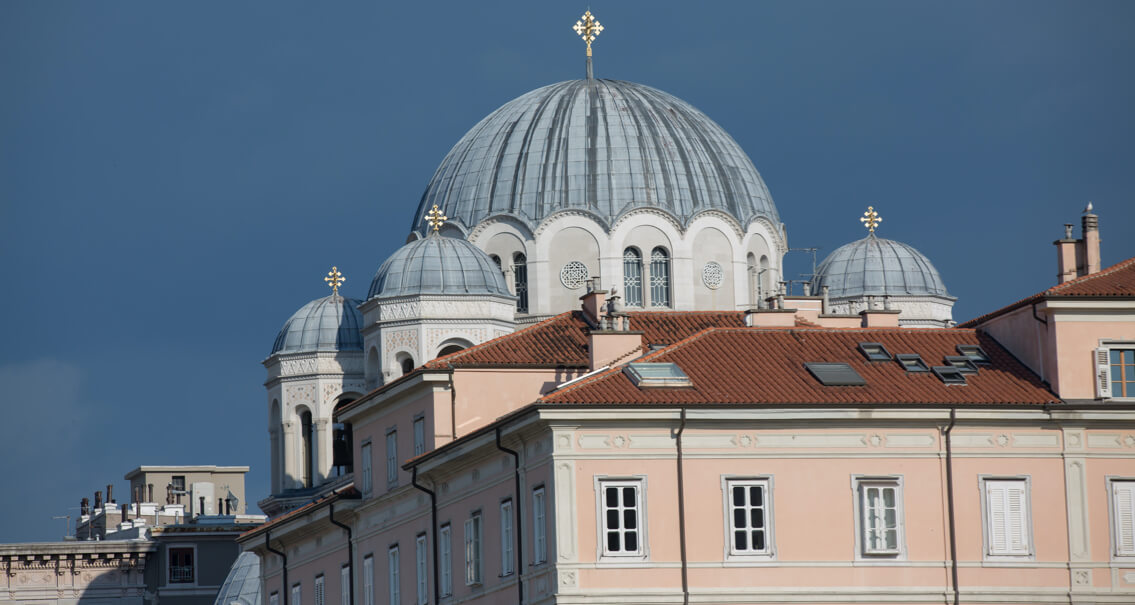
New Temple / Нови храм
Of course, the success of these efforts depended not only on the Serbian Church. For this reason, the Serbs who lived in these parts, but above all the representatives of the Church, with great wisdom committed themselves to establishing and maintaining balanced relations with the Austrian Imperial Authorities in the often unstable historical circumstances, while always remaining faithful to their Church and their people.
This behavior was also adopted by our small community whose life, although advantaged in some respects, at the same time had to face numerous difficulties.
It was fortunate that the Greeks, relatively soon after their settlement and with the arrival of the Serbs in the city, obtained permission from the Imperial Authority in Vienna to erect their own church and found their own community. Helping them in the construction of the church and in repaying the debt to Empress Maria Theresa were their Serbian brothers.
The disagreements between the two Orthodox communities, which arose from conflicting opinions regarding which priest should perform the Sacred Liturgies and in which language, did not discourage the Serbs from persevering in the struggle to obtain the same rights as their Greek brothers, nor from living and working as honest people. According to historian Djordje Rajković, great help and support for the Serbs was given by the Metropolitan of Sremski Karlovci, Pavle Nenadović, who promoted their cause before the Imperial Power. With the decision of the Austrian Empress in 1757, the Serbs, together with the Greeks, were included in the jurisdiction (spiritual government) of the Bishop of Gornji Karlovac, Danilo Jakšić, of the Serbian Orthodox Church which operated on the territory of the Austro-Hungarian Empire through the Archdiocese of Sremski Karlovci. With this decision, the Habsburg Empire protected its interests and confirmed the privileges previously conferred on the Serbian people.
It should be emphasized that this important religious community (the Serbian Orthodox Religious Community of St. Spyridon of Trieste), from its earliest days until today, has never abandoned the link with the Serbian Orthodox Church.
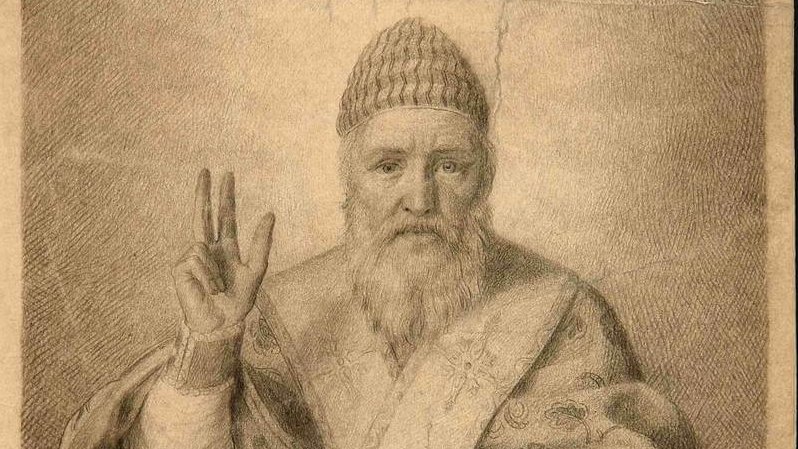
S. Spyridon / Св. Спиридон
His spiritual life was taken over by the Serbian bishops, the most famous of whom was Lukijan Mušicki (a well-known Serbian writer and poet). Even today the Community preserves the antimins with his name. In the church of St. Spyridon it was the priests of the Serbian Church who celebrated the Liturgies (the historian M. Purković speaks of a number of about 60), some of the best known were: Vićentije Rakić, Haralampije Mamula, Savatije Knežević, Nićifor Vukadinović. The names of some well-known hierodeacons also appear: Vikentije Ljuština, German Andjelić and others (about 13).
As good pastors, they taught the devotees to cherish their faith and to nourish love for God and their fellow countrymen. At the same time, by setting an example by their behavior, they taught them to be good and honest workers, as well as to respect their neighbors and fellow citizens.
The Serbs of Trieste today
Being the largest of the ethnic groups that have recently settled in the city, most Serbs arrived in Trieste after the earthquake in Friuli and after the dissolution of the former Yugoslavia. Mostly from Eastern Serbia, they represent an important element of the life of Trieste and its economic development. Thanks to their exemplary conduct and the honest way in which they carry out their professions, the Serbs enjoy the great respect of the local population. Distinguished by their skill in the field of construction and crafts, they contribute with great success to the construction and renovation of the city. Together with them, but present in smaller numbers, Serbian intellectuals enrich the city fabric with their valuable knowledge, thus contributing to the improvement of the reputation of their compatriots.
The Serbian Orthodox Religious Community helps its compatriots in their adaptation to the new country, but also in the preservation of their religious, national and cultural identity. This is done in several ways: by regularly celebrating the Holy Liturgies (every day, on Sundays and on religious holidays), by organizing catechism, Serbian language and history lessons for school-age children (divided into 3 groups) in the after-school program, as well as Italian language lessons for adults and Serbian language for all those interested in learning our language. Through various activities (folk dance classes, singing, literary activities, trips) the Community is committed to maintaining the link with its young people. In addition, it helps and supports all associations whose goal is the preservation of the spiritual, national and cultural identity of the Serbian people.
In addition to these ordinary activities, our Community hosts various conferences and exhibitions, organizes pilgrimage trips, concerts of religious, classical and folk music and carries out many other activities that contribute to the preservation of the spiritual, cultural and national identity of the Serbian people, but at the same time also to their better integration in the new country.
The parish priest, proto-priest-stavrophore Raško Radović